SnapRoamer.com – Symmetry in travel photography creates a sense of stability and order, making it ideal for architectural landmarks and mirror-like water reflections. Conversely, asymmetry introduces tension, movement, and engagement, often driving viewers to spend more time examining off-center compositions for a more dynamic visual experience.
Glenn Guy notes that symmetry allows a photographer to introduce a sense of order into a world of chaos. This principle is particularly useful when capturing the rigid geometry of historic buildings or modern skyscrapers that feature 180-degree architectural alignments.
The Smartphone Lens Guide: Symmetry vs. Asymmetry across Focal Lengths
The mathematical difficulty of achieving perfect symmetry changes with your lens: Ultra-wide (0.5x) lenses exaggerate perspective distortion, making symmetry harder to align in tight spaces, while Telephoto (3x) lenses compress the scene, making it easier to isolate symmetrical patterns but harder to capture wide asymmetrical landscapes.
Ultra-wide (0.5x) and the distortion trap
When utilizing the ultra-wide lens on a smartphone camera, the inherent barrel distortion can cause straight vertical lines to curve outward. This creates a specific failure mode for symmetrical shots where a building that appears balanced in reality looks warped in the frame. To combat this, photographers often need to move further back to minimize edge distortion or use post-processing to correct the perspective. While wide angles are excellent for capturing vast landscapes, they demand extreme precision in centering the subject to prevent the image from feeling “lopsided” due to optical stretching.
Telephoto (3x) for pattern isolation
Switching to a 3x telephoto lens changes the compositional math by compressing the distance between foreground and background elements. This compression makes it significantly easier to isolate repeating, symmetrical patterns in textures or architectural details. However, a common pitfall occurs when attempting to capture wide asymmetrical landscapes with this lens; the narrow field of view often cuts off the very elements needed to balance the frame. Using a telephoto lens requires a more deliberate approach to “framing within a frame” to ensure the compressed view remains intentional rather than accidental.
Combatting AI ‘Auto-Correction’ to Preserve Intentional Tension
Modern smartphone cameras are programmed to identify “perfect” scenes, which can inadvertently strip away the artistic value of an asymmetrical shot. If a photographer intentionally places a subject off-center to create tension, the device’s internal processing may attempt to re-center or “fix” the composition, resulting in a flattened, uninteresting image.
Why ‘Scene Optimizer’ ruins asymmetry
Many devices include a “Scene Optimizer” or similar AI-driven mode that recognizes landmarks and automatically adjusts framing and lighting. While this helps casual users, it can be detrimental to professional-grade travel photography. For example, if the AI detects a mountain, it might force a centered, symmetrical composition that ignores a more compelling, asymmetrical foreground element. To maintain creative control, users should navigate to Settings > Camera > Scene Optimizer (or equivalent path) and disable these automated suggestions.
How to disable Auto-Leveling for artistic tension
Auto-leveling features are designed to keep the horizon perfectly straight, which is helpful for landscapes but can ruin an asymmetrical shot intended to convey a sense of unrest. Asymmetry can add a unique sense of unrest or emphasis to images, and a perfectly level horizon might counteract that feeling. Practitioners often find that disabling the automatic tilt correction allows them to utilize diagonal lines more effectively. Check your camera’s Composition Guides menu to ensure you are seeing the true orientation of your frame before the software intervenes.
The Mechanics of Balance: Symmetry vs. Asymmetry
Symmetrical balance creates stability and harmony by evenly distributing elements, making it the simplest way to create a solid feeling of balance. Asymmetrical balance creates engagement and tension by using different textures, patterns, or off-center subjects to direct the viewer’s eye across the frame.
| Feature | Symmetrical Balance | Asymmetrical Balance |
|---|---|---|
| Visual Effect | Stability and Order | Movement and Tension |
| Viewer Feeling | Calm and “In-place” | Obscure or “On-edge” |
| Primary Use Case | Architecture & Reflections | Street & Dynamic Landscapes |
The distinction between these two modes is fundamental to how a viewer interacts with a photograph. While one offers a resting point for the eyes, the other demands active exploration.
Symmetry: The pursuit of order
Symmetry is often the most straightforward way to achieve a sense of balance. In symmetrical balance, there is a sense of stability and harmony because the elements in the frame are evenly distributed. This is particularly effective in landscape photography, where mirror-like reflections on water can create striking, perfectly balanced images. When the left side of the frame mirrors the right, the viewer experiences an immediate sense of completion and peace.
Asymmetry: The power of unrest
Asymmetry does not mean a lack of balance; rather, it is a more complex form of equilibrium. PetaPixel notes that asymmetry may direct the viewer to look more at one side or another, creating a sense of movement. This can be achieved through the use of different textures and patterns to weight different parts of the frame. Instead of mirroring an object, an asymmetrical composition might balance a large, dark subject on one side with a smaller, brightly lit subject on the other, forcing the eye to travel through the scene.
Mastering Compositional Frameworks: From Rule of Thirds to the Golden Ratio
Compositional frameworks act as the mathematical scaffolding for both symmetrical and asymmetrical shots. While symmetry often relies on the center line, asymmetry thrives on the mathematical intersections of the frame.
- rule of thirds: A method of dividing the frame into a 3×3 grid to place subjects along lines or at intersection points.
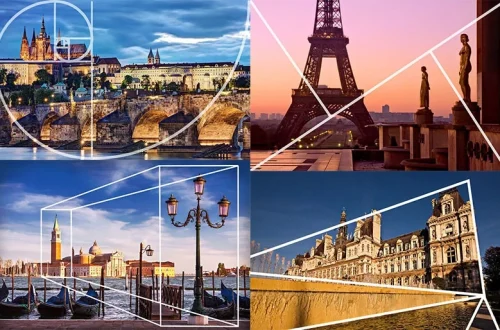
- Golden Ratio / Phi Grid: A more complex division based on the 1:1.618 ratio, providing a more organic sense of balance.
- Golden Spiral: A compositional tool that uses a logarithmic spiral to lead the eye through a sequence of focal points.
- Triangular Groupings: Placing 3 elements in a triangle to lead the eyes in a pleasing way.
The 3×3 Grid vs. the 1:1.618 Ratio
The Rule of Thirds is a widely used tool that utilizes a 3×3 grid to simplify composition. However, a common misconception is that the Rule of Thirds is a simplified version of the Golden Ratio; it is not. They are distinct compositional tools with different mathematical foundations. The Golden Ratio uses a 1:1.618 ratio, which often results in a more natural, less “obvious” feeling of balance compared to the Rule of Thirds. While the 3×3 grid is easier to apply quickly on a smartphone, the Phi Grid or Golden Ratio offers a more sophisticated way to place subjects for high-end travel imagery.
Using the Golden Spiral for dynamic movement
For shots that require a sense of flow—such as a winding path in a forest or the curve of a coastline—the Golden Spiral is an essential framework. By placing the primary subject at the smallest part of the spiral and allowing the curve to lead the viewer’s eye through the rest of the frame, photographers can create a sense of continuous motion. This is a powerful way to implement asymmetry, as the weight of the image is distributed along a mathematical curve rather than a straight line.
Triangular groupings for eye guidance
When dealing with multiple subjects in a travel scene, such as a group of people or a cluster of buildings, triangular composition is highly effective. By placing 3 elements in a triangle, you can lead the viewer’s eyes in a pleasing way across the frame. This technique prevents the eye from getting “stuck” on a single point and encourages a more thorough examination of the entire composition, whether the overall shot is symmetrical or asymmetrical.
Practical Smartphone Execution: Avoiding Common Pitfalls
Even with a strong understanding of theory, the physical constraints of using a handheld smartphone can undermine your compositional intent. Execution requires both technical awareness and environmental vigilance.
The danger of the ‘cluttered edge’
One of the most frequent mistakes in travel photography is failing to “clean” the edges of the frame. A perfectly symmetrical shot of a cathedral can be completely ruined if a random object, such as a trash bin, is left in the frame edges. Similarly, in asymmetrical shots, a distracting background or foreground element can pull focus away from the intended subject. Always perform a final sweep of the frame edges before pressing the shutter to ensure no clutter is breaking your compositional logic.
Stability issues in handheld symmetry
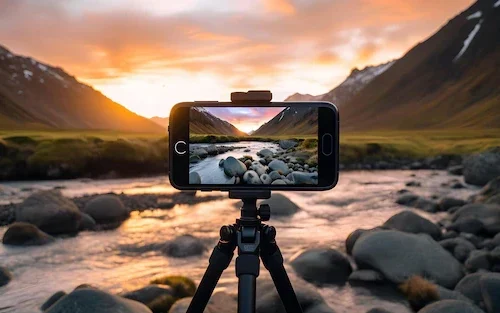
Achieving perfect symmetry requires precise alignment, which is difficult to maintain when holding a device by hand. When shooting symmetry without a tripod, there is an increased chance of camera shake, which can cause the horizon or vertical lines to tilt slightly. Even a minor tilt can turn a symmetrical masterpiece into a failed composition. To mitigate this, consider using the smartphone’s volume button as a physical shutter trigger to minimize movement, or lean against a wall to stabilize your hands during long exposures or critical alignments.
FAQ
Is the Rule of Thirds just a simplified Golden Ratio?
No, the Rule of Thirds is not a simplified version of the Golden Ratio; they are distinct compositional tools with different mathematical foundations. While both use grids to guide placement, the Golden Ratio is based on the 1:1.618 proportion, offering a more organic feel.
How can I achieve perfect symmetry on a smartphone?
To achieve perfect symmetry, use the “Grid Lines” feature in your camera settings to align your subjects with the center axes. For more advanced effects, you may consider using specialized smartphone apps like KaleidaCam or MirrorArt to create artificial symmetry in post-processing.
Why do viewers prefer asymmetrical compositions?
Studies suggest viewers spend more time examining off-center compositions, as the lack of immediate symmetry creates more engagement and visual interest. The tension created by asymmetry forces the brain to work harder to find balance, making the image more memorable.