SnapRoamer.com – smartphone photography in Buddhist temples requires a balance of technical precision and deep cultural respect. To avoid legal trouble or disrespect, travelers must follow strict etiquette: never turn your back to a Buddha statue when exiting, avoid flash in sacred interiors like Wat Phra Kaew, and always dress modestly to honor the sanctity of the space.
In Myanmar, climbing pagodas with your shoes on can lead to fines or even arrest under the Myanmar Penal Code Section 295 regarding the defilement of places of worship. Such legal consequences emphasize that what may seem like a simple photography mistake can be interpreted as a serious criminal offense.
The Stealth Photographer: Why your smartphone is the ultimate tool for respect
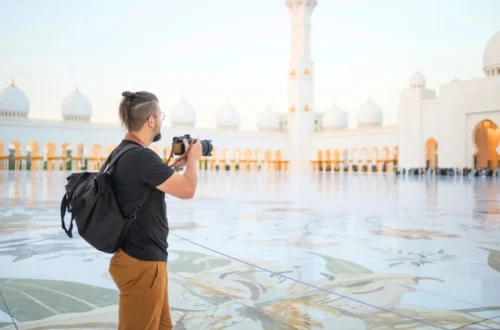
A smartphone’s small form factor facilitates discreet street photography. This allows for capturing rituals without the social discomfort of Meiwaku caused by bulky equipment.
A smartphone is often superior to a DSLR in Buddhist temples because its small form factor allows for ‘discreet street photography.’ This unobtrusive nature helps you capture candid, respectful moments of monks or rituals without the ‘bulky camera’ stigma that can disrupt ceremonies or cause social discomfort (Meiwaku).
Avoiding the ‘Bulky Camera’ stigma
Large professional cameras often signal a “tourist” presence that can inadvertently disrupt the meditative atmosphere of a shrine. Using a smartphone allows you to blend into the background of worshippers. This is particularly useful when trying to capture the scale of a site like the Dambullah cave temples, where 153 Buddha statues are housed within a complex of rock-cut sanctuaries. A large lens can feel intrusive in these confined, sacred spaces.
Capturing candid rituals without disruption
To maintain the principle of Meiwaku—avoiding causing trouble or annoyance to others—the smartphone provides several advantages:
- Discreet framing: You can hold the device at waist level to avoid the silhouette of a large lens.
- Silent operation: Using the physical volume buttons to trigger the shutter can often be quieter than tapping a screen, especially in quiet prayer halls.
- Quick retraction: If a monk or nun enters a worship area, a smartphone can be placed in a pocket instantly, whereas a DSLR requires a deliberate and visible movement to stow.
Prioritize social harmony over technical perfection. A high-quality mobile shot that respects the sanctity of a ritual is more valuable than a technically flawless image that causes a distraction.
Smartphone Pro-Mode Cheat Sheet for Temple Lighting
For dim temple interiors, switch your smartphone to ‘Pro Mode’ and aim for an ISO between 800-1600 with a shutter speed of approximately 1/30s. Use positive exposure compensation to brighten shadowed subjects, and rely on ‘Night Mode’ if you cannot use a tripod to avoid motion blur.
Settings for candlelit shrines
When shooting near flickering candles, manually adjust your ISO to the 800-1600 range. This helps capture enough light without overwhelming the sensor with digital grain.
| Setting/Mode | Best Use Case | Impact on Image |
|---|---|---|
| Manual (Pro) Mode | Dim interiors or high-contrast corridors | Maximum control over shutter and ISO |
| Night Mode | Low light without a tripod | Uses computational stacking to reduce blur |
| Program Mode | Bright, outdoor pagodas | Balanced exposure with minimal effort |
| Low ISO (100-400) | Bright daylight/Outdoor | Highest image clarity and lowest noise |
| High ISO (800-3200) | Candlelit shrines/Dusk | Increases light sensitivity but adds noise |
Use the settings in the table to manage light sensitivity and clarity.
Managing high-contrast outdoor pagodas
When photographing massive structures like the granite rock formations at Dambullah, you will face harsh sunlight. To prevent the sky from turning pure white or the temple details from becoming black silhouettes, use exposure compensation. If the temple facade is too dark against a bright sky, move your exposure slider toward the positive (+) side to brighten the subject.
Critical Etiquette: Avoiding Legal and Spiritual Pitfalls
Follow the rules and traditions of the local country to avoid conflict. As Aung Aung Kyaw notes, failure to follow local customs can lead to legal action.
WARNING: In regions like Bagan, climbing pagodas with your shoes on can lead to legal action and arrest. Always follow local signage regarding footwear and restricted areas.
The ‘Exit Rule’: Walking backwards with respect
When exiting, you should walk backwards and get some distance between yourself and the Buddha before turning your back. This practice shows proper respect for the image.
Body language: Feet, hands, and thresholds
Observe these specific prohibitions to maintain decorum:
- The Foot Rule: Never point your feet at a person or an image of Buddha. In many Buddhist cultures, feet are considered the lowest and least clean part of the body.
- The Threshold Rule: When entering a building, step over the temple threshold, not on it. The threshold is often considered a sacred boundary.
- No Selfies: Taking selfies with Buddha statues is considered highly disrespectful. Avoid posing with the statues; instead, focus on the architecture or the atmosphere.
Navigating Venue Restrictions and Sacred Spaces
Photography rules often vary by site. Some locations have specific prohibitions on certain subjects or areas.
Understanding gender-based restrictions
Women are not permitted to enter some chedis and smaller buildings at some temples. Always check for signage or ask a local guide before attempting to enter a restricted structure for a photo opportunity.
When to put the phone away
Certain sites have absolute prohibitions. For example, Wat Phra Kaew (the Temple of the Emerald Buddha) prohibits interior photography to protect religious sanctity and prevent flash disturbance during worship. If you see signs or staff members indicating no photography, comply immediately. Furthermore, photography of monks requires permission. Never capture images of monks during meditation, prayer, or formal ceremonies without explicitly asking first.
Technical Mastery: Managing Light and Perspective
To document sites like the 153 Buddha statues at Dambullah accurately, you must understand how light interacts with the environment.
Correcting vertical convergence in architecture
When shooting tall structures like Wat Arun, tilting your smartphone upward often causes the vertical lines of the temple to “lean” inward. This is known as vertical convergence. To manage architectural perspective, try to position your smartphone as parallel to the building facade as possible. If you must tilt the phone, you will need to use software to correct the perspective in post-processing.
Balancing shadows and highlights
Use these technical guidelines to manage light extremes:
| Scenario | Technical Approach | Target Value |
|---|---|---|
| Bright Outdoor Sun | Low ISO | 100-400 ISO |
| Dim Interior Shrines | High ISO | 800-3200 ISO |
| Exposure Compensation | Positive (+) for shadows |
Apply these settings to maintain technical accuracy when documenting sacred sites.
Social Media Ethics: Appreciation vs. Exploitation
Avoid using a sacred site as a mere “backdrop” for a trendy dance or a provocative pose. True appreciation involves capturing the light, the texture of the murals, and the quiet dignity of the space.
FAQ
Can I use a tripod in a Buddhist temple?
Generally, tripods are prohibited in crowded or restricted areas to prevent congestion (Meiwaku). Use a smartphone’s built-in ‘Night Mode’ or lean your device against a stable surface instead.
Is it okay to take selfies with Buddha statues?
No. Taking selfies with Buddha is considered highly disrespectful. To show respect, avoid posing with the statues and maintain a respectful distance.
What should I do if I need to turn around while facing a Buddha image?
To avoid being disrespectful, you should walk backwards for a few steps to create distance between yourself and the Buddha before turning your back.