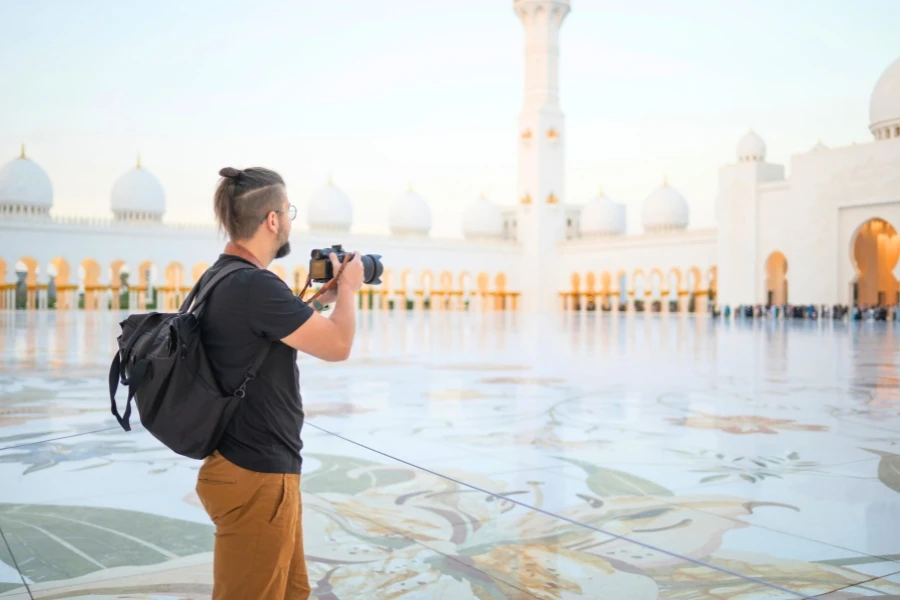
SnapRoamer.com – Respectful smartphone photography in a mosque requires following specific guidelines, such as the rule from bluemosque.tr: “The most critical rule of respectful photography inside the Blue Mosque is to never take photos of people while they are praying.” Additionally, avoid flash photography, as it is strictly forbidden because it is disruptive and disrespectful.
As noted by bluemosque.tr, “Photography is a privilege here, not a right.”
The Silent Shutter: Mobile Etiquette for Quiet Prayer Halls
To maintain a respectful atmosphere, ensure your smartphone is on silent mode and use ‘Live Photo’ or ‘Silent Shutter’ settings to eliminate mechanical clicking sounds. This prevents disrupting the spiritual focus of worshippers during the five daily prayer times.
Mosques are active places of worship. Disrupting the five daily prayer times with sudden noises can break the concentration of those in prayer. Practitioners report that even a small notification sound or a sharp shutter click can be highly intrusive in a quiet prayer hall.
Muting the Shutter on iOS and Android
To ensure your device remains silent, you must actively disable the camera shutter sound within the specific application settings. Do not rely solely on the volume rocker.
- iOS Users: Navigate to Settings > Sounds & Haptics and ensure the “System Sounds” or “Camera Shutter” volume is turned down. Alternatively, use the physical Ring/Silent switch on the side of the device.
- Android Users: Open the Camera app, tap the Settings icon (often a gear shape), and toggle off “Shutter Sound.”
- The “Live” Alternative: Using the “Live Photo” feature on iPhone can often mitigate the harshness of a mechanical-sounding click by integrating the sound into a brief video clip.
Shortcut: Use the “Do Not Disturb” mode in your control center to silence all incoming calls and notifications before you enter the prayer area.
Avoiding the ‘Loud Tourist’ Syndrome
Avoid walking in front of someone who is praying, as it is considered disrespectful. Keep your physical footprint small. Use one hand to steady your phone if possible, rather than spreading your arms wide to frame a shot, which can inadvertently obstruct the view of others or create a visual distraction.
Low-Light Smartphone Masterclass: Capturing Dim Interiors
Since tripods are strictly forbidden in the Blue Mosque, you must adjust your settings to avoid camera shake. Avoid using flash, as it is strictly forbidden for being disruptive.
To achieve better results without a tripod, leverage your device’s software. Most modern smartphones feature a dedicated Night Mode that takes multiple exposures and merges them to reduce noise.
- Exposure Compensation: When you tap to focus on a dim area, a sun icon or slider usually appears. Slide it down slightly to prevent the highlights (like lanterns) from blowing out.
- ISO Management: While you want to keep noise low, you may need to allow your ISO to climb. Aim for a range between 800 and 3200 to capture enough light without turning the image into a grainy mess.
- Aperture Simulation: While you cannot change a smartphone’s physical aperture, using the 0.5x ultra-wide lens can help capture more light and context in tight spaces.
Overexposing a mosque interior can wash out the intricate textures of the carpets or calligraphy. It is often better to have a slightly underexposed, moody shot than a bright, flat, and unrealistic one.
Stabilizing Handheld Shots without a Tripod
Without a tripod, your biggest enemy is “camera shake.” If your shutter speed drops too low, the image will blur. To maintain sharpness, try to keep your shutter speed at least at 1/50th of a second if you are using a standard focal length. You can achieve this by leaning your shoulder against a pillar or holding your breath momentarily while pressing the shutter button. A common failure mode is trying to zoom in digitally in low light; this significantly increases grain and reduces sharpness. It is better to take a wide shot and crop later.
The Human Element: Consent and the Ethics of Portraiture
You should always avoid taking photos of people without their consent to respect their privacy and dignity.
WARNING: Never point your camera at believers during their ablution process outside the mosque. This is considered highly disrespectful and a violation of personal privacy.
The Ablution (Wudu) Boundary
Do not point your camera at believers during their ablution process outside the mosque. This is a major breach of etiquette and is considered disrespectful.
Asking Permission with Non-Verbal Cues
In many cultures, a verbal request might be difficult due to language barriers. If you wish to capture a portrait, use non-verbal cues. A polite nod, a smile, and a gentle gesture toward your camera can communicate your intention. If the person turns away or shakes their head, respect that decision immediately and move on. As Itimaar notes, capturing memories should never come before humility and reverence in these sacred sites.
Architectural Composition: Using Symmetry and Rhythm
Mosque architecture often utilizes geometric principles to create a sense of order. To capture this, move beyond simple snapshots and use the structure’s inherent design.
Using a wide-angle lens is highly effective for capturing the scale of massive domes and repeating arches. To improve your composition, go to your smartphone camera settings and turn on grid lines. This helps you straighten horizons and ensure that your vertical lines—such as pillars and minarets—are perfectly upright.
Grid Lines for Perfect Symmetry
Many mosques, including the Blue Mosque, feature intense central symmetry. Use the grid lines on your screen to align the central axis of the dome or the main prayer rug with the center of your frame. This creates a sense of balance that mirrors the spiritual order of the space.
Leading Lines in the Courtyard
The courtyards of major mosques often feature repeating arches and walkways. Use these as leading lines to draw the viewer’s eye toward a central point, such as a fountain or a distant minaret. By standing in the center of a courtyard and using a wide-angle lens, you can create a powerful sense of depth and rhythm.
Global Variations in Mosque Photography Rules
Photography regulations vary by location. Restrictions and cultural nuances change depending on whether you are in Istanbul, Morocco, or Saudi Arabia.
| Location | Key Restriction | Photography Nuance |
|---|---|---|
| Istanbul (e.g., Blue Mosque) | No Tripods | High visitor volume requires constant movement; stay out of the way. |
| Morocco (e.g., Hassan II Mosque) | Non-Muslim Restrictions | Interior access for non-Muslims can be limited; check local mosque rules. |
| Saudi Arabia (Hajj/Umrah) | Professional Gear | DSLRs and large lenses are often restricted; stick to smartphones. |
In Istanbul, sites like the Hagia Sophia can see up to 50,000 visitors daily. The primary challenge here is managing high traffic while remaining respectful. In Morocco, travelers should be aware that photography in certain mosque interiors may be restricted for non-Muslims. Always check the specific rules of the local site before setting up your shot.
Conflict Resolution: Handling Requests to Stop
If a guard or local asks you to stop, follow their instructions immediately. Your response determines whether you are seen as a respectful guest or a disruptive tourist.
If a staff member asks you to stop, do not argue or attempt to explain that you “weren’t doing anything wrong.” This often escalates the situation. Instead, follow a simple de-escalation protocol.
Shortcut: If asked to stop, immediately lower your phone, offer a polite nod or a slight bow of the head, and move to a different area. This shows that you acknowledge their authority and respect the sanctity of the space.
When to Delete a Photo Immediately
If you accidentally capture a close-up of someone praying or violate a specific rule, offer to show the staff your screen and delete the image in their presence. This transparency can prevent a misunderstanding from turning into a confrontation.
Social Media Ethics: Posting Sacred Spaces
When uploading images of sacred sites to platforms like Instagram or TikTok, be mindful of the religious context. Your posts contribute to the global perception of these spaces.
Avoid using heavy filters that might obscure the religious context of the mosque. A photo that prioritizes aesthetics over the site’s dignity can feel disrespectful to those who view the site as a place of worship.
Tagging vs. Respect
While tagging the location is helpful for others, be mindful of how you use hashtags. Using overly casual or irreverent hashtags alongside photos of sacred spaces can be seen as a lack of reverence. Aim to use descriptive, respectful tags that honor the cultural and religious significance of the location.
FAQ
Can I use a tripod in the Blue Mosque?
No, tripods are strictly forbidden in the Blue Mosque to ensure visitor flow and respect for the sacred space.
Is flash photography allowed in mosques?
Flash photography is strictly forbidden in mosques because it is considered highly disruptive to worshippers and disrespectful to the atmosphere.
Should I ask permission before photographing people?
Yes, even if photography is permitted in the mosque, you should always seek consent before taking portraits of individuals to respect their privacy and dignity.