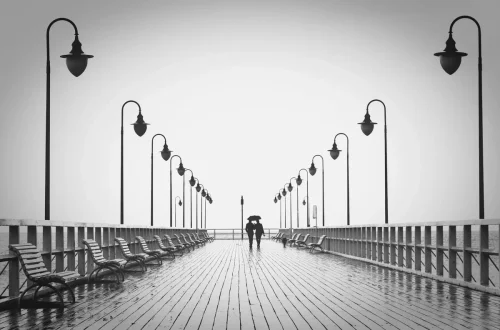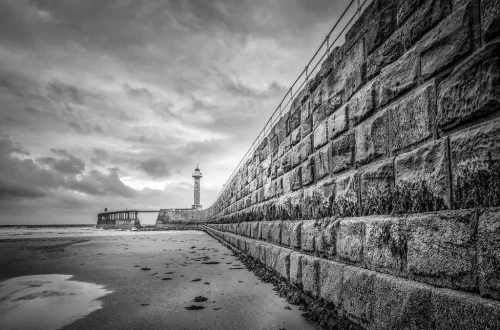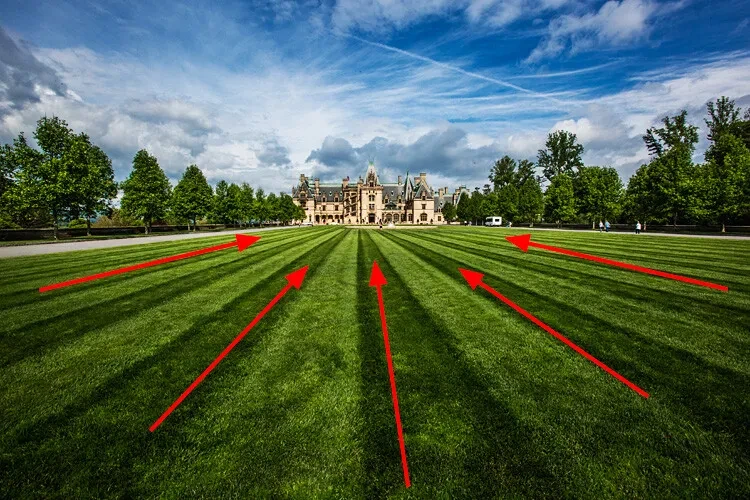
SnapRoamer.com – Leading lines are compositional elements—natural or man-made—that guide a viewer’s eye through a photograph toward a specific subject or the heart of the image. By utilizing paths, rivers, or even shadows, photographers create a sense of depth, movement, and three-dimensional illusion within a two-dimensional frame. Leading lines can be anything from a massive dirt road to a repetitive sequence of small objects like railroad tracks or a line of trees, as noted by photographer Felipe Silva.
The Troubleshooting Guide: Avoiding the ‘Exit Trap’ and ‘Distraction Trap’
The ‘Exit Trap’ occurs when leading lines unintentionally guide the viewer’s attention completely off the edge of the frame. The ‘Distraction Trap’ happens when a line points toward a secondary, stronger subject instead of your intended focal point, breaking the visual narrative and confusing the viewer.
Identifying the False Lead
A common failure mode in landscape photography involves horizontal leading lines leading off-page. When a road or river edge exits the frame without pointing toward a focal point, the viewer’s gaze follows the line out of the image, resulting in a loss of interest. Practitioners report that lines deviating from the subject are among the most frequent mistakes that quietly ruin a photograph. This creates a visual “dead end” where the narrative of the image simply stops.
Correcting Line Direction in Post-Processing
If a line is slightly misaligned, it can often be salvaged. While you cannot create a new path that wasn’t there, you can adjust the orientation. One method involves using the crop tool to re-center the convergence point. If the horizon is tilted, it can typically be straightened in about 10 seconds during post-processing. Using the camera’s built-in level during the initial shoot is the most efficient way to avoid this, but software corrections remain a standard safety net.
- Check for lines that point to empty space.
- Ensure the strongest line terminates at your subject.
- Avoid having multiple lines competing for attention in different directions.
Beyond Roads and Rivers: Harnessing Texture-Based and Implied Lines
The search for visual guides extends far beyond obvious structures. According to Felipe Silva, “Leading lines can be anything. They can be a road or a line of trees leading you somewhere. They can be people and repetitive objects, like railroad tracks.”
Micro-leading lines in sand and rock strata
Texture provides a subtle, sophisticated way to direct the eye. In desert environments, the repetitive ridges of sand ripples act as micro-leading lines. Similarly, the distinct layers of rock strata in canyon walls create natural paths that guide the eye through the geological history of the frame. These lines are often less “aggressive” than a road, making them ideal for minimalist compositions.
The power of shadow and light patches
Light itself can act as a guide. Shadows cast by trees or mountain peaks create dark, directional paths that contrast against illuminated areas. By utilizing the interplay of light and dark, a photographer can create implied lines. These are not physical objects, but rather a sequence of light patches that the brain connects to form a visual path. This technique is particularly effective when using a wide-angle lens, which makes these patterns more obvious and dramatic.
The Geometry of Emotion: How Line Direction Dictates Mood
Different line orientations trigger distinct psychological responses: horizontal lines convey stability and reliability; vertical lines emphasize height, strength, or dominance; and diagonal lines inject dynamism, energy, and a sense of movement into the composition.
| Line Orientation | Psychological Impact | Best Use Case |
|---|---|---|
| Horizontal | Stability and reliability | Wide landscapes, calm seas, or flat plains |
| Vertical | Height, strength, or dominance | Tall trees, skyscrapers, or mountain peaks |
| Diagonal | Dynamism and energy | Paths, rivers, or crashing waves |
Photographers use specific orientations to control the narrative. Felipe Silva notes that horizontal leading lines, such as a path leading to a straight river or a fallen tree, are mostly used in landscape photography to convey stability because they are ongoing and reliable.
Horizontal: The anchor of stability
Horizontal lines provide a sense of rest. They are often used to ground a composition, providing a firm base for the viewer. When a path or a fallen tree lies horizontally, it suggests a peaceful, unchanging environment.
Vertical: Commanding the frame
Vertical lines emphasize scale. They are perfect for emphasizing the height of tall buildings, trees, or pillars. A vertical line creates a sense of power and can make a viewer feel small in comparison to the subject.
Diagonal: The engine of movement
Diagonal lines are never static. They suggest action and can imply depth by leading from the foreground into the background. The s-curve, a specific type of winding diagonal, is a popular tool that adds a profound sense of depth and dynamism to an image.
The Physics of Perspective: Focal Length and Line Aggression
A photographer’s choice of lens determines how these visual paths manifest. Because most leading lines are not obvious and depend on the photographer’s ability to recognize them, the choice of focal length is a critical technical decision.
Wide-angle exaggeration
Using a wide-angle lens makes leading lines more obvious. wide-angle lenses exaggerate the perspective, making the distance between the foreground and background appear much larger. This increases the “aggression” of a line, making a road appear to rush toward the viewer with significant speed and drama. This is a primary way to create a 3D illusion in scenic landscape photography.
Telephoto compression vs. line speed
In contrast, telephoto lenses cause compression. While a wide-angle lens stretches the line, a telephoto lens pulls the background closer, making the leading line appear shorter and less dramatic. While this can be used to simplify a composition, it reduces the sense of “speed” or “rush” that a wide-angle lens provides. A photographer must choose between the dramatic exaggeration of a wide lens and the organized, compressed layers of a telephoto lens.
Post-Processing Workflow to Enhance Visual Paths
Digital tools serve to reinforce the compositional intent. If a line is present but subtle, techniques like dodging and burning can be used to increase its visual weight.
Shortcut: Use the Dodge and Burn tools to selectively brighten or darken areas along a path to increase its visual weight.
Increasing contrast with Dodging and Burning
Dodging and burning is one of the most effective ways to enhance leading lines. By “burning” (darkening) the edges of a path or river and “dodging” (brightening) the center, you create a high-contrast track that the eye cannot ignore. This adds a sense of three-dimensional volume to the line, making it pop against the surrounding landscape.
Experimental color inversion for dimension
For highly experimental work, photographers can use color inversion to study or create new dimensions. In Photoshop, you can follow these 4 easy steps: 1. Open the image file. 2. Add a new Invert layer. 3. Create dimension. 4. Adjust levels. This can help you see the “skeleton” of your lines more clearly by flipping the color scheme to its polar opposite, allowing you to identify where the visual weight truly lies.
- Use Linear Gradients to darken distracting skies that pull focus away from ground-level lines.
- Apply Dehaze to increase the clarity of distant lines that have been lost to atmospheric haze.
- Use the Invert tool to check the tonal values of your paths.
FAQ
Can leading lines be used in non-landscape photography?
The technique is highly versatile. Beyond landscapes, professionals use leading lines when constructing cityscape shots, street photos, architectural images, and even macro work to direct focus and create balance.
What is the best lens for emphasizing leading lines?
A wide-angle lens is highly effective because it exaggerates perspective, making lines more obvious, dramatic, and aggressive, which helps guide the eye more forcefully toward the subject.
How do I fix a tilted horizon that ruins my lines?
Use the camera’s built-in level during shooting to ensure accuracy. If the mistake is caught later, it typically takes only about 10 seconds to straighten the horizon during post-processing.