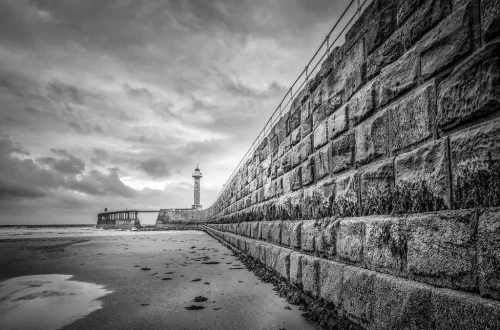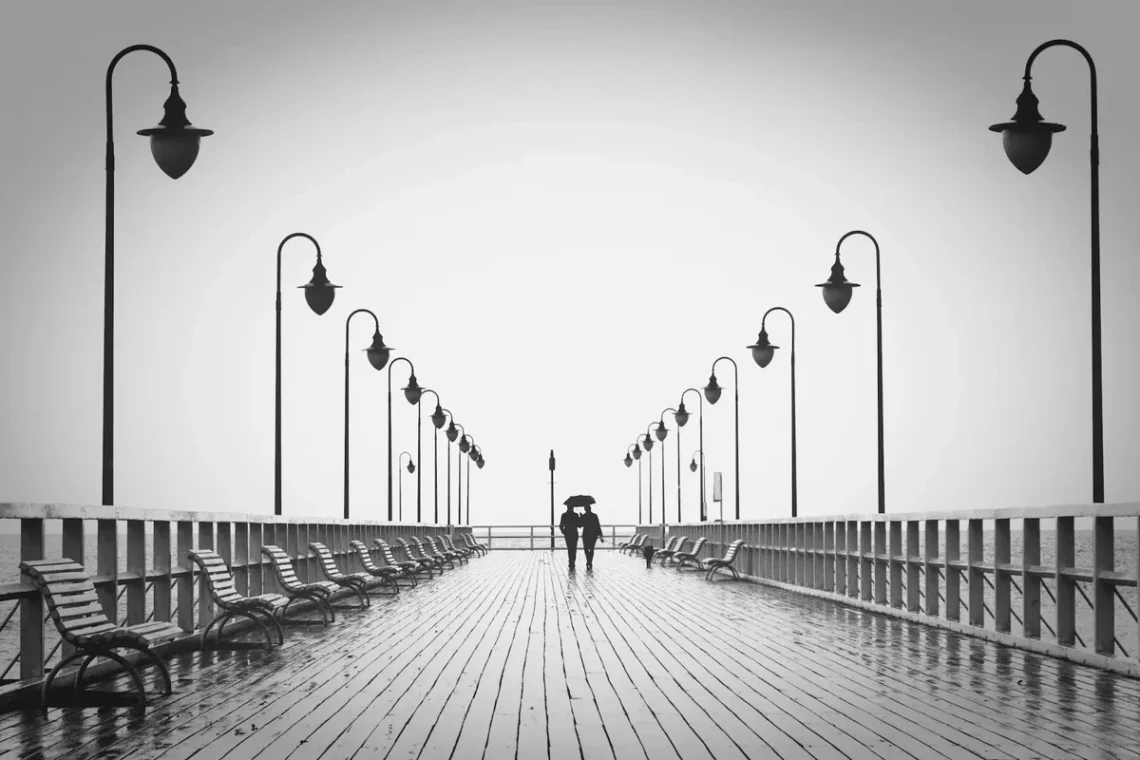
SnapRoamer.com – Leading lines serve as a compositional technique to direct a viewer’s attention. According to Lukas Kosslow, these human-made or natural lines lead the viewer’s eyes through a photograph to the subject or the heart of the image.
Leading lines are defined as a technique where human-made or natural lines lead the viewer’s eyes through a photograph to the subject or the heart of the image.
Beyond the Road: Mastering Non-Physical Leading Lines
Visual paths can exist without solid edges. Photographers can utilize light beams or color gradients to guide the eye. These non-physical paths act as directional tools within the frame.
The Implied Line Masterclass: Human Gaze and Movement
Compositional direction does not always require a tangible object. Implied lines can be formed by the direction a person is looking, the path of a dancer’s leap, or even the sequential positioning of objects in a scene. When a subject stares intensely at a specific point, the viewer’s brain instinctively follows that gaze, creating a psychological connection between the subject and the destination. This method is highly effective in portraiture and street photography to create narrative depth without cluttering the frame with physical structures.
Chiaroscuro: Using Light and Shadow as Paths
To make light beams appear more dramatic, practitioners often use a low angle. This technique creates high-contrast transitions that act as directional paths. If the light source is too diffused, it can wash out the edges and flatten the composition.
Color Gradients as Visual Guides
Color transitions function as subtle guides. A sharp boundary between two contrasting hues acts as a visual track. For example, a high-contrast color boundary can steer the eye across a landscape. While many beginners search for physical fences or roads, mastering the transition between color temperatures or saturation levels provides a more sophisticated method of directing attention.
The Psychology of Tension: How Line Geometry Affects Mood
The geometric structure of a line influences how a viewer perceives an image. Different shapes carry specific emotional weights, such as the stability of a horizontal line or the energy of a diagonal one.
| Line Type | Primary Emotional Impact | Best Use Case |
|---|---|---|
| Horizontal | Peace and tranquility | Landscapes and calm seascapes |
| Vertical | Power and confidence | Architecture and fashion portraiture |
| Diagonal | Action and dynamism | Sports and high-energy street scenes |
| Curved | Grace and elegance | Nature and flowing water |
| Interrupted | Tension and interest | Complex compositions to break monotony |
Photographers can match these geometric structures to their intended narrative. By selecting specific line types, they control the emotional tone of the shot.
Stability vs. Chaos: Horizontal and Vertical Dynamics
Silva notes that horizontal leading lines are mostly used in landscape photography. You can use a path or a dirt road leading to a straight river or a fallen tree to convey a sense of stability. Conversely, vertical lines convey power and confidence. This is why vertical leading lines are prevalent in fashion photography, portraiture, and street photography, where the subject needs to command presence.
The Neurological Response to Interrupted Lines
Interrupted lines can create tension in an image and add interest to the composition by breaking up the monotony of a continuous line. This disruption forces the eye to work harder to complete the path.
Core Types of Leading Lines in Composition
Compositional variety is achieved through several primary types. These include horizontal lines for stability, vertical lines for power, diagonal lines for energy, curved lines for grace, and converging lines for 3D perspective.
- Straight Lines: These provide the most direct paths and are foundational for structural compositions.
- Curved Lines: These add a sense of movement and can lead the eye on a journey through the frame. Lukas Kosslow suggests that curved lines are among the best types because they can bring the viewer’s eye through the entire image.
- Converging Lines: These happen when two or more lines meet at a point far away, making things look more 3D.
- Diagonal Lines: These imply motion and energy. Silva observes that diagonal lines often emphasize distance from the foreground to the background.
Straight Lines: The Foundation of Structure
Straight lines often consist of man-made elements like railings, walls, or roads. While they offer an efficient route to a subject, they can feel rigid if not balanced with other elements.
The S-Curve: Adding Elegance to Landscapes
The S-Curve is a specific application of curved lines. By using a winding path that twists and turns in an S-shape, photographers add depth and dynamism to a scene. This is particularly effective in landscape photography to guide the eye from the immediate foreground into the distant background in a fluid, graceful motion.
Converging Lines and One-Point Perspective
Converging lines are essential for creating a sense of three-dimensional depth on a two-dimensional surface. To execute this effectively, photographers can use the One-Point Perspective technique: arrange elements whose lines converge at a single vanishing point on the horizon to create a strong focal area. This creates a powerful sense of scale and pulls the viewer deep into the image.
The Leading Line Troubleshooting Guide: Avoiding Common Pitfalls
A line can become a distraction if it fails to point toward the intended subject. Compositional success depends on the line’s destination.
Warning: A leading line that does not terminate at a subject or a meaningful area of interest is a visual distraction that drains energy from your photograph.
The ‘Exit Trap’: When Lines Lead Eyes Off-Frame
In landscape photography, horizontal lines can mistakenly lead attention off the page. If a line exits through the side without hitting a subject, the viewer’s eye follows it out of the photograph. This leaves the actual subject ignored.
The Subject Overpowering: Finding the Balance
Lines must serve the subject. A frequent error occurs when the geometric weight or contrast of the lines is so heavy that the viewer becomes obsessed with the path itself rather than the focal point.
Post-Capture Line Correction: Strengthening Lines in Editing
Digital post-processing can enhance weak lines. This is especially useful for brightening subtle light paths or adjusting geometric structures.
Shortcut: In many editing suites, using the Transform or Perspective tool is the fastest way to correct converging lines that are leaning too heavily in one direction.
Using Cropping to Redirect the Eye
Cropping can reorient a line so it points directly toward the focal point. This works well with the rule of thirds with Leading Lines: place the subject off-center on a third line and use the lines to draw the viewer’s eye towards that intersection point.
Dodging and Burning to Enhance Visual Paths
To strengthen a line, one can use dodging (lightening) and burning (darkening) techniques. By darkening the edges of a path or brightening the center of a light beam, you increase the local contrast. This makes the “invisible” or subtle lines more prominent, ensuring the viewer’s eye follows the intended trajectory through the frame.
FAQ
Can a line be ‘invisible’ in photography?
Yes. Implied lines can be formed by a person’s gaze, while non-physical lines can be created through light beams and color gradients.
What is the best way to use leading lines with the Rule of Thirds?
Place your subject off-center on a third line and use the leading lines to point directly toward that intersection point.
Why do my leading lines feel distracting?
Lines may be overpowering the subject or leading the eye out of the frame. Ensure every line has a clear destination.