SnapRoamer.com – According to Adobe, composition in photography is simply the way elements are arranged in a scene to make the photo “work.” It is a deliberate manipulation of the frame by the artist.
Composition is equivalent to the foundation of your house; without proper composition, no amount of editing can fix your image.
The Compositional Troubleshooting Checklist: Why Your Photos Feel “Off”
To diagnose poor composition, check for three main culprits: weight imbalance (is one side too heavy?), distracting edges (is an object cutting into the frame?), and gaze collisions (is the subject looking into a “wall” of dead space?). Identifying these issues prevents the need for heavy overediting later.
Many common photography mistakes, such as overediting, are often a symptom of the core problem: poor composition (Adorama). While many beginners attempt to fix a lackluster image through aggressive color grading or contrast adjustments in software, these are often bandages for a fundamentally broken frame. If the structural integrity of the shot is missing, the final result will remain unconvincing.
Identifying Weight Imbalance
A photograph can feel physically lopsided if the visual weight is not distributed effectively. This occurs when a large, dark, or highly detailed subject occupies one side of the frame without a counterweight on the opposite side. Achieving balance does not always mean symmetry; in fact, asymmetrical compositions will feel more lively and dynamic (Canon Europe).
The “Gaze Wall” Error
A frequent failure mode in portraiture involves ignoring subject direction. This happens when photographing people without leaving space in the direction they are looking (Belinda Shi). When a subject’s gaze or movement is directed toward the edge of the frame, it creates a sense of confinement or “hitting a wall,” which disrupts the natural flow of the image.
Distracting Edge Elements
Compositional quality often collapses due to a lack of breathing space. This occurs when placing subjects too close to each other or crossing primary subjects with unimportant ones (Spencer Cox). Practitioners should also watch for “edge clutter,” where an object partially enters the frame, creating a visual distraction that pulls the eye away from the intended focal point.
- Check for subjects crowded against the frame boundaries.
- Ensure primary subjects are not intersected by secondary, unimportant objects.
- Verify that the subject has enough “room to breathe” in their direction of travel or gaze.
A Technical-Composition Matrix: How Settings Alter Your Frame
Composition is linked to mechanical settings. For instance, a photographer can use movement via shutter speed to alter the scene. Using a slow shutter speed creates motion blur, while a fast shutter speed freezes action (RMCAD).
Aperture dictates the depth of field, which allows a photographer to use selective focus to isolate a subject from a cluttered background. By widening the aperture, the photographer can “compose” using blur, effectively removing distracting elements from the equation. Conversely, shutter speed manages the temporal aspect of composition, allowing for the depiction of time through motion.
| Setting | Compositional Effect | Visual Result |
|---|---|---|
| Slow Shutter Speed | Motion Blur | Conveys fluid movement or time passing |
| Fast Shutter Speed | Freeze Action | Isolates a single moment in time |
| Wide Aperture | Shallow Depth of Field | Isolates subject via background blur |
| Narrow Aperture | Deep Depth of Field | Maintains sharpness across the entire scene |
Understanding this relationship is vital. For example, using a slow shutter speed in a crowded environment can turn chaotic movement into a smooth, compositional element, whereas a fast shutter speed might freeze a distracting object in a way that ruins the frame’s balance.
Mastering the Fundamentals: From Rule of Thirds to Leading Lines
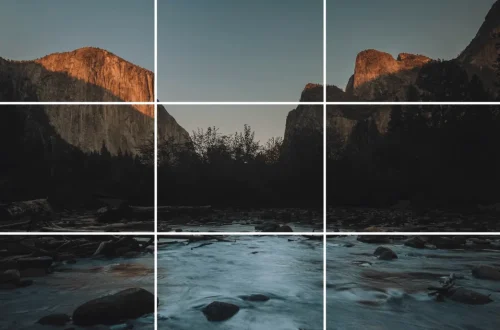
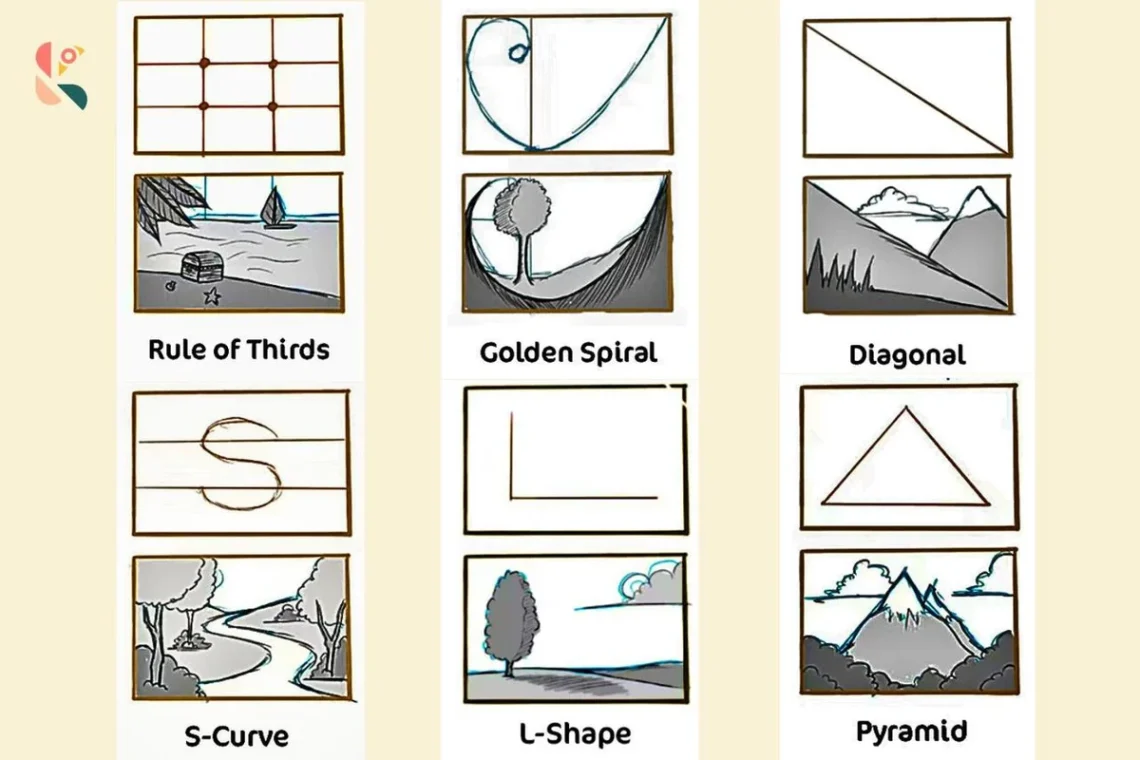
The rule of thirds involves dividing your frame into a 3×3 grid of nine equal sections. By positioning your subject on these lines or at their intersections, you create more natural, engaging compositions than simple centering.
The Rule of Thirds is the most widely used and followed compositional rule in the world (Adorama). Invented by Kodak in the 1970s, this technique utilizes a 3×3 grid to break the monotony of centered subjects. By placing the most important elements—such as a person’s eyes or a distant mountain peak—along these lines or at the four intersection points, the photographer creates a more sophisticated sense of balance.
The 3×3 Grid Method
To implement this, most modern cameras and smartphones offer a “Grid view” in their settings menu. On a professional camera, you can often find this under the Display or Setup menu paths. Utilizing this grid helps the photographer align subjects with mathematical precision, ensuring the eye is led to the correct focal point immediately upon viewing the image.
Guiding the Eye with Lines
leading lines are a powerful tool used to guide the viewer’s eye toward a specific point of interest (Adorama). These can be natural, such as a winding river, or man-made, such as a road or a fence. When using lines, photographers should ideally aim for diagonal lines running from the bottom left to the top right, as this matches the accustomed reading direction in most Western cultures.
The Power of Negative Space
Negative space involves utilizing empty areas in the frame to add scale, context, or mood (Adorama). Rather than filling every corner of the frame with detail, leaving “empty” space—such as a clear sky or a plain wall—can simplify a scene and prevent visual clutter. This technique is particularly effective for emphasizing the isolation or smallness of a subject within a vast landscape.
The Mathematics of Beauty: Rule of Thirds vs. Golden Ratio
While the Rule of Thirds is a practical starting point, more advanced compositions often rely on mathematical proportions found in nature. The Golden Ratio, characterized by the 1.618 ratio (phi), offers a more complex method of arrangement that can create a sense of organic harmony.
The Rule of Thirds provides an easy-to-use structure for beginners. In contrast, the Golden Ratio adds dynamism and emphasizes movement by creating a more fluid path for the eye to follow (Expert Photography).
| Technique | Primary Benefit | Complexity Level | Best Use Case |
|---|---|---|---|
| Rule of Thirds | Ease of use and quick alignment | Low | General snapshots and portraits |
| Golden Ratio | Natural dynamism and organic flow | High | Fine art and complex landscapes |
Interestingly, these mathematical patterns extend beyond visual art. For example, the Golden Ratio point appears in musical composition, where a specific duration of 61.8% is often used to create a sense of climax or resolution (IJMTT).
Compositional Pitfalls: What to Avoid to Save Your Shot
Avoid common errors to ensure a high-quality final image. One such pitfall is centering the subject when trying to create an interesting or creative image (Adorama).
One of the most common mistakes is centering the subject when trying to create an interesting or creative image (Adorama). While centering can work for specific symmetrical subjects, it often results in a static, uninspired photograph. Additionally, as noted by Rivera, once the basics are mastered, experimentation is key, but beginners often struggle because they treat these guidelines as rigid laws rather than flexible frameworks.
Warning: Overediting is frequently a symptom of poor initial composition. If a photo feels “off,” do not attempt to fix it by adding heavy filters or extreme contrast; instead, go back to the source and re-evaluate your framing.
- Avoid centering subjects unless symmetry is the specific goal.
- Do not ignore subject direction; always leave “lead room” in front of a moving or looking subject.
- Watch for “dead space” that lacks any narrative or compositional purpose.
FAQ
Can I fix bad composition in post-production?
Yes, you can often improve a slightly off composition using the Crop tool in software like Photoshop to move the edge of the frame and re-align subjects. However, heavy cropping can lead to a loss of image resolution and detail.
Is the Rule of Thirds a strict requirement?
No. According to See Imagery, the “rules” are more like training wheels that help you ride, but eventually you take them off. Rivera also notes that once you have the basics down, you can experiment without set rules.
How does negative space affect a photo?
Negative space is a technique used to add scale or tell a story in an image (Adorama). It simplifies the scene to prevent visual clutter.