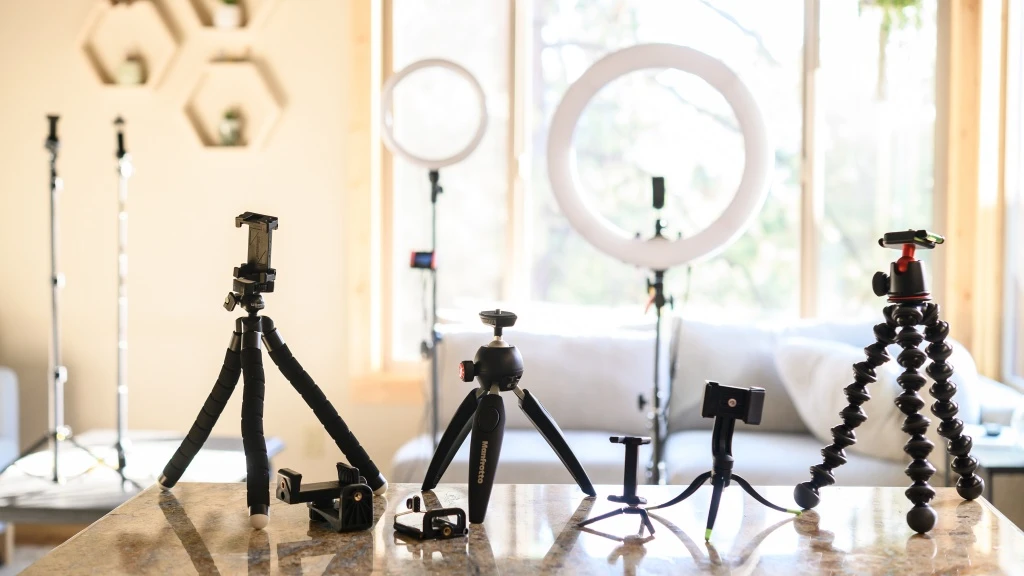
SnapRoamer.com – The best smartphone tripod depends on your environment: use a Joby GorillaPod for uneven terrain, a Manfrotto PIXI for stable tabletop shots, or a DJI Osmo Mobile for professional-grade vlogging. For maximum security, prioritize mechanical spring-loaded clamps over purely magnetic mounts to prevent accidental drops during long-duration filming.
Professional testing by experts reveals that stability often depends more on the mount’s grip than the tripod’s legs.
The Mobile Studio: Building a Rig Beyond the Tripod
To build a professional mobile studio, combine a sturdy tripod with accessories via cold-shoe mounts. Use a tripod with integrated accessory slots to attach LED lights and external microphones, ensuring your setup can handle the ‘top-heavy’ effect of extra gear without tipping.
Expanding a mobile setup requires moving beyond a simple phone clamp to a modular ecosystem. Using brands like SmallRig, creators can integrate specialized hardware to manage the weight of additional peripherals. A common failure mode occurs when users attach a heavy microphone without checking the tripod’s center of gravity, causing the entire rig to pitch forward.
Integrating Audio and Lighting
Adding peripherals necessitates a mount that supports more than just the handset. The Ulanzi ST-27 is a notable example, offering more flexibility for angles and accessories compared to simpler mounts, and it is faster to set up. When rigging, practitioners should aim for a balanced distribution of weight. For instance, attaching a light to one side of a lightweight tripod can easily exceed the 4.4 lb weight limit of smaller tabletop models like the Benro Tablepod Flex.
The Cold-Shoe Advantage
The inclusion of cold-shoe mounts allows for professional-grade expansion. A sophisticated mobile rig often utilizes these slots for:
- External LED panels for consistent lighting.
- Directional microphones to isolate voice.
- Bluetooth remote shutter triggers for hands-free operation.
Counterintuitively, a more expensive tripod is not always a better “studio” base; the utility often lies in the mounting interface rather than the leg material. For advanced multi-angle recording, some creators utilize specialized apps like RECnGO to manage the workflow between the phone and the mounted accessories.
Stability Failure Guide: Why Tripods Tip Over
Tripod failure typically stems from two physical imbalances: an offset center of gravity or insufficient leg tension. When a smartphone is mounted with a heavy case or attached to an external lens, the weight shifts away from the tripod’s central axis, creating a lever effect that pulls the legs inward or outward.
The Center-of-Gravity Trap
A common mistake involves using a tripod like the KraftGeek Variety Tripod for heavy setups. While it has a maximum load of 2 kg, its 450 g frame is designed for portability, not heavy-duty stabilization. If the phone is positioned too far toward the edge of the clamp, the tripod will tip. This is particularly dangerous when using the Neewer Smartphone Holder Vertical Bracket if the weight is not centered.
Telescopic Column Wobble
Many tabletop models feature adjustable heights, but this comes with a mechanical trade-off. Raising the telescopic column on the Benro Tablepod Flex introduces significant wobble, making it less ideal for heavy equipment or windy outdoor conditions. To mitigate this, keep the center column as low as possible during high-stakes filming. If you must extend it, ensure the tripod is placed on a non-slip surface to prevent the feet from sliding under the increased leverage.
Top Picks for Every Smartphone User
Selecting the right model requires matching the tripod’s mechanical strengths to your specific filming environment. The following selection is based on stability, build quality, and specialized use cases.
| Model | Best Use Case | Max Load/Height | Key Feature |
|---|---|---|---|
| Joby GorillaPod 1K | Rugged/Outdoor | Flexible Legs | Versatile Grip |
| DJI Osmo Mobile 6 | Vlogging | Stabilized Gimbal | ActiveTrack Tech |
| Peak Design Mobile | Travel/Compact | Ultra-Portable | Integrated Mount |
| Manfrotto PIXI | Tabletop | Up to 2.5 kg | Compact Stability |
The comparison above highlights that specialized tools, such as the DJI Osmo Mobile 6, serve different needs than static supports like the Manfrotto PIXI.
The Best for Rugged Terrain: Joby GorillaPod 1K
For users operating in unpredictable environments, the Joby GorillaPod 1K stands out. Its signature flexible, jointed legs can bend into just about any position, and once you place them, they stay put. This makes it superior to cheaper models that tend to slip when nudged lightly. It is sturdier and more practical for various conditions because it is designed with more useful, rugged features.
The Best for Vlogging: DJI Osmo Mobile 6
Vloggers require movement rather than static stability. The DJI Osmo Mobile 6, priced at approximately 139 US$, provides motorized stabilization that a standard tripod cannot match. While a tripod holds a position, this device tracks subjects, making it the primary choice for creators who move while filming.
The Best for Travel: Peak Design Mobile Tripod
Portability is the priority for the mobile traveler. The Peak Design Mobile Tripod, retailing for 79.95 US$, offers a footprint that fits easily into a pocket. It sacrifices the height and load capacity of a full-size tripod for extreme ease of deployment.
The Best for Tabletop Stability: Manfrotto PIXI
For stationary shots on a desk or cafe table, the Manfrotto Pixi Mini Tripod Kit is a professional standard. At 44.95 US$, it provides a reliable base. Notably, the Manfrotto Pixi EVO 2 is also considered one of the best mini tripods for phone devices due to its robust build. It can support loads up to 2.5 kg, which is significantly more than most consumer-grade mini tripods.
Case Compatibility: Will Your Phone Fit?
A frequent point of failure in smartphone photography is the physical dimensions of the device. Many users find that after adding a rugged protective case, their phone no longer fits into standard clamps.
- Width Constraints: The Arkon MG21420 supports a maximum phone width of 3.25 inches. If your phone is equipped with an oversized protective case, it may exceed this limit.
- Clamp Limits: The Manfrotto PIXI smartphone clamp can accommodate a maximum phone width of 83 mm.
- Mounting Style: Ensure your mount is compatible with your specific case type. For example, MagSafe-compatible cases work well with magnetic mounts, but for long-duration video, a mechanical clamp is safer.
If you are using a phone that exceeds 83 mm in width, you must look for wider-aperture clamps to avoid the risk of the phone twisting out of the mount and falling.
Quick Decision Tree: Which One Should You Buy?
Choosing a tripod depends on your primary filming location and the amount of gear you carry. Use the following logic to narrow your search.
If you are hiking or filming in nature: Choose the Joby GorillaPod 1K for its ability to wrap around branches.
If you are a solo vlogger on the move: Choose the DJI Osmo Mobile 6 for active tracking.
If you are filming product shots on a desk: Choose the Manfrotto PIXI or Benro Tablepod Flex.
If you need a full-size travel solution: The Joby RangePod Smart Tripod is a strong contender, capable of reaching a maximum height of 160 cm.
Shortcut: For immediate stability in most indoor settings, prioritize the Manfrotto PIXI.
FAQ
Is MagSafe better than a mechanical clamp?
While MagSafe offers speed, mechanical clamps like the Ulanzi ST-27 provide superior security for long-duration video to prevent the phone from twisting out of position.
Can I use a mini tripod for a DSLR?
Only if the tripod’s payload capacity allows. While mini tripods work for phones, you must verify the weight limit (e.g., Manfrotto Pixi supports up to 2.5kg) before mounting a DSLR.
How do I stop my tripod from wobbling?
Avoid extending telescopic columns on lightweight models like the Benro Tablepod Flex in windy conditions, and ensure you are using rubber feet for surface grip.